Construction Skip Counting by Twos
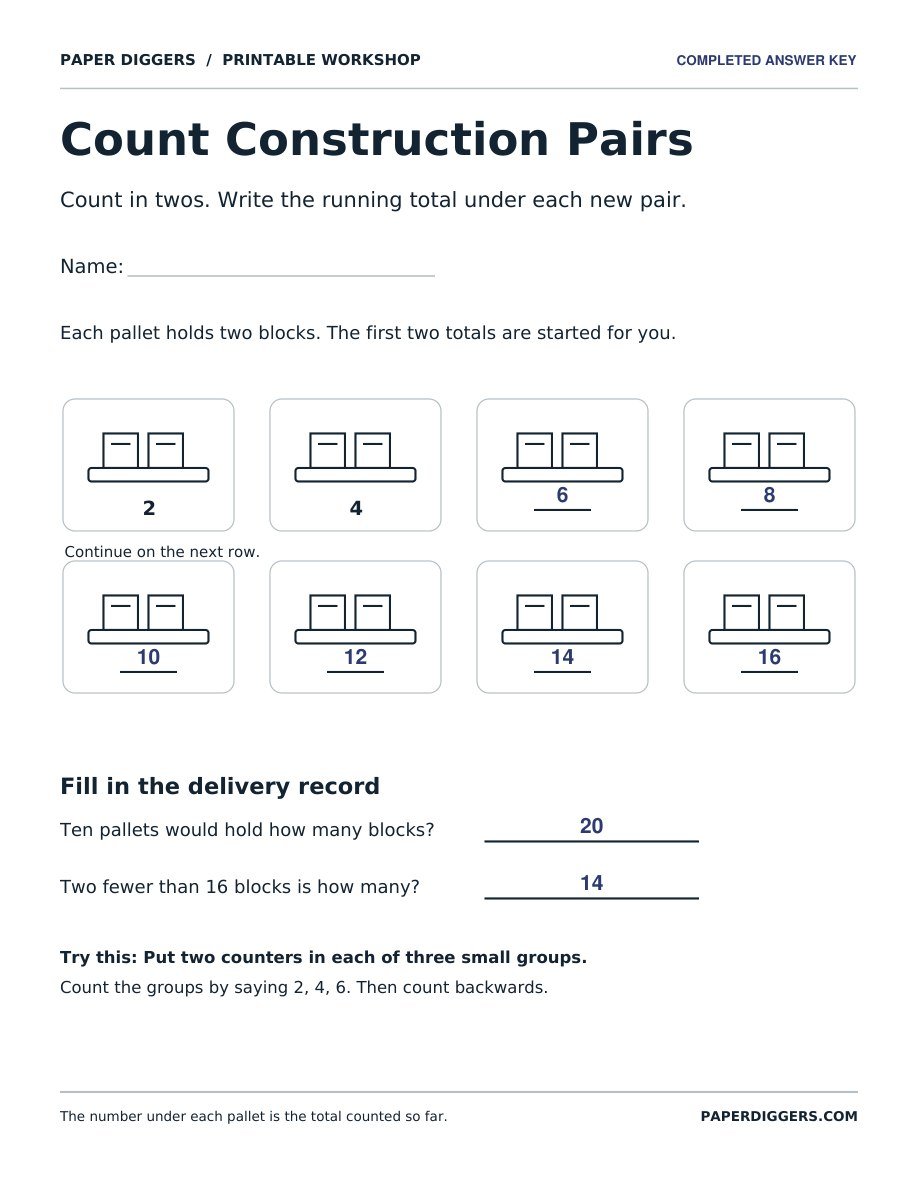
Each pallet carries two blocks. Keep a running total as eight pallets are loaded, then use the pattern to solve two delivery questions without drawing extra pallets.
At a glance: One black-and-white page. Bring a pencil and, if useful, some counters. Print at Actual Size or 100%. The answer key is below.

Count each pair once
- Point to the first pallet and say two. Point to the second and say four because four blocks have been counted so far.
- Continue along the top row, then start on the left of the bottom row. The first pallet on the second row comes after four pallets already counted, so its label is 10, not 2.
- For ten pallets, start at 16 and add two twice. For two fewer than 16 blocks, picture taking away one whole pallet.
Help a learner who restarts at the second row
Cover the bottom row. Ask how many blocks have already been loaded, then uncover just the first pallet below and add its two blocks to eight. A finger or a scrap of paper can help keep the place while the learner works across the pictures.
Tell the number of pallets from the number of blocks
Ask, “There are 18 blocks with two on every pallet. How many pallets is that?” The picture ends at eight pallets and 16 blocks. One more pair makes 18, so there are nine pallets. Then reverse it: remove one pallet at a time and say 18, 16, 14, 12.
Try another activity
Worksheet at a glance
- SkillPractice skip counting by twos
- Best forLearners who can count a small group by ones
- TimeAbout 10 minutes
- You needPrinted sheet and a pencil
Count the first pair as two, then say one number per additional pair. The numbers are running totals, not labels for separate pairs.
Common questions
What is skip counting?
It means counting in equal steps instead of counting by ones. Here each step adds two.
What if the learner loses track?
Point to each pair as a unit and stop to check the total using individual objects.