Construction Position Words
Find the traffic cone on each small grid, then draw a circle one square to the left, above, or to the right. The cone moves between examples, so start from the cone rather than from the middle of the grid.
At a glance: One black-and-white page, three grids and a pencil. Print in portrait at Actual Size or 100%. Answers are below.

Start at the cone each time
- Read the instruction aloud and point to the cone on that grid.
- For left or right, slide a finger one square along the same row. For above, go one square up and stay in the same column.
- Draw the circle after checking the move. There should be only one circle in each grid.
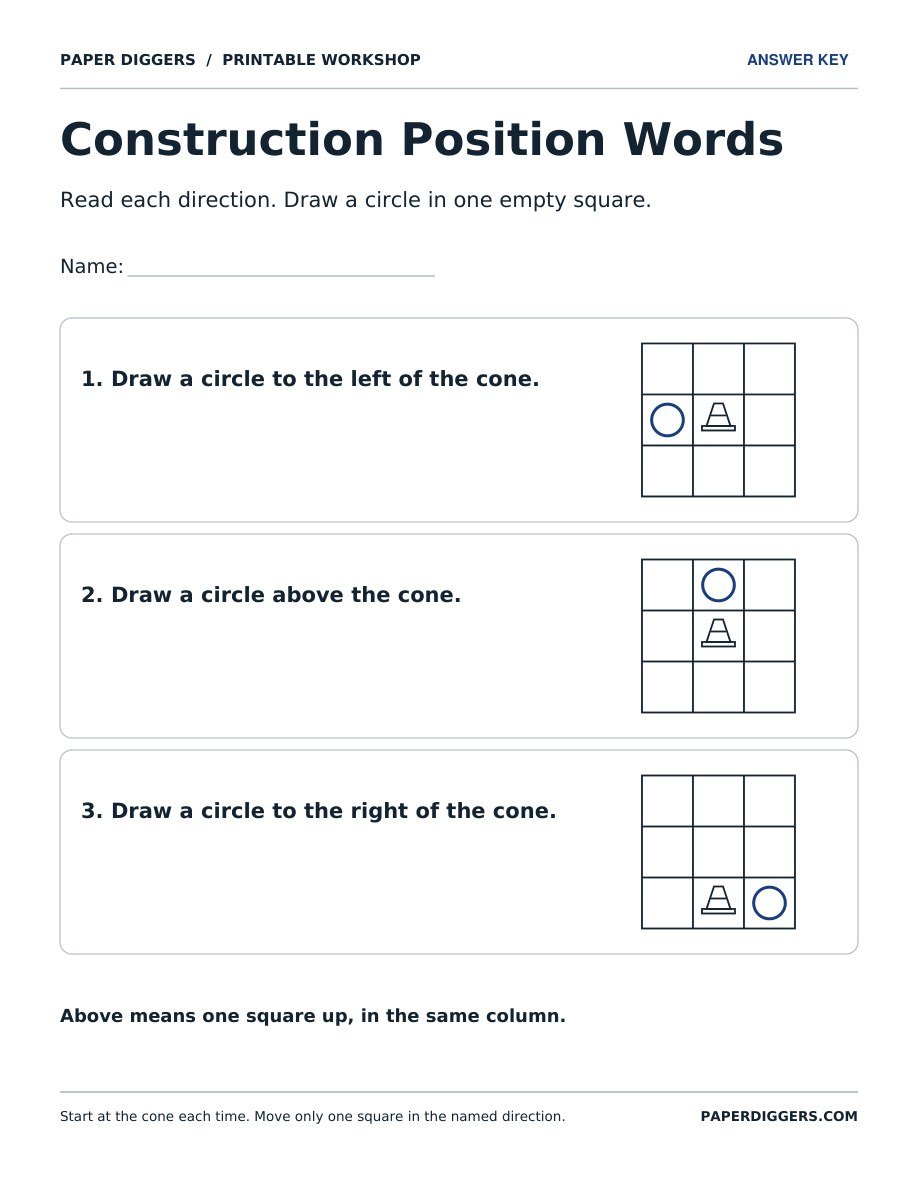
When “above” turns into a diagonal
Ask the learner to trace the vertical edge of the cone’s square up with a finger. The correct square sits directly over the cone, not one row up and one column over. If they move to the middle row on the last grid, remind them that moving right keeps them in the cone’s row.
Make it a partner game
Draw a fresh three-by-three grid and place a counter as the cone. One person names a valid one-square move; the other makes it and repeats the direction aloud. For a harder round, make two moves in sequence and describe the final square relative to the start.
Keep exploring
Worksheet at a glance
- SkillUse position words in a construction scene
- Best forLearners practicing spatial language
- TimeAbout 10 minutes
- You needPrinted sheet and a pencil
Name the two objects first. Then tell where the first one is in relation to the second.
Common questions
Why do I need to name a reference object?
A position such as beside or above only makes sense when you know what it is beside or above.
What makes this easier?
Point to the reference object, then point to the object whose position you want to describe.